

How Long Kids Wear Palatal Expanders: A Parent's Timeline
Reviewed by Dr. Michael K. Wilkerson, DDS, pediatric dentist in Boerne, TX · Updated November 14, 2026
Last Updated: November 14, 2026
Quick Summary
A palate expander usually stays in for several months to about a year. The turning phase is short, often a couple of weeks to about a month. Then the expander stays in place without turning for several more months while new bone fills in, so the wider jaw stays wide.
- Turning phase: often about 1 to 4 weeks, depending on the plan.
- Holding phase: usually several months; in studies, often six months or longer.
- A gap between the front teeth during turning is common and usually closes on its own.
- Missed a turn? Don't double up. Call the office.
- Loose expander, swelling, or pain that's getting worse? Stop turning and call the same day.
Table of Contents
- How Long Kids Wear Palatal Expanders: The Short Answer
- What a Palate Expander Does
- Types of Expanders
- What Age Is Best for an Expander?
- Expanders and Braces
- What You’ll Notice Along the Way
- Missed a Turn or a Loose Expander
- Normal vs. When to Call
- Early Orthodontics at The Kid’s Place in Boerne
- Frequently Asked Questions
How Long Kids Wear Palatal Expanders: The Short Answer
Most kids wear a palatal expander for several months to about a year. Parents often hear “a few weeks of turning” and expect the expander to come out after that, but turning is only the first part.
| Phase | Typical length | What happens |
|---|---|---|
| Turning (active expansion) | Often about 1 to 4 weeks | You turn a small screw with a key, usually once or twice a day, as directed. The upper jaw slowly widens. |
| Holding (retention) | Usually several months; often 6 months or more in studies | No more turning. The expander stays in while new bone fills the gap. |
| Total | Several months to about a year | Your child’s plan may be shorter or longer. |
These ranges come from a 2026 review of expander studies in children, where turning lasted from about 10 days to about a month, and expanders were then held in place for six months to a year. Your child’s dentist or orthodontist will set the exact schedule based on how much widening is needed.
What a Palate Expander Does
The upper jaw starts out as two halves joined by a seam down the middle of the roof of the mouth (the midpalatal suture). In children, that seam hasn’t fully fused yet. An expander gently pushes the two halves apart, and the body fills the gap with new bone.
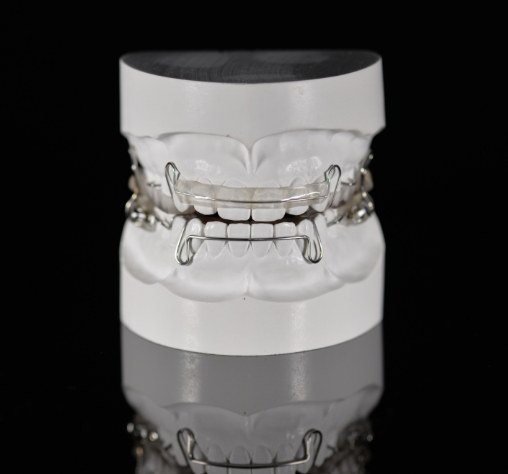
- The expander is fitted to the upper back teeth and sits against the roof of the mouth.
- A small screw in the middle connects the two sides.
- Each turn of the key widens it a tiny amount, about a quarter of a millimeter.
- Once the jaw is wide enough, turning stops and the expander holds the new width while bone forms.
A wider upper jaw can correct a crossbite (when the upper back teeth sit inside the lower teeth) and make more room for adult teeth. For the bigger picture, see our guide to early interceptive orthodontics.
Types of Expanders
- Fixed expanders with a key: cemented to the back teeth, so they work all day. Parents turn the screw at home on a set schedule. This is the most common type for kids.
- Spring-loaded expanders: some newer fixed designs widen with a built-in spring and are adjusted at the office, so there’s no turning at home.
- Removable expanders: come out for eating and brushing. They’re used for smaller changes and only work if your child wears them as directed.
What Age Is Best for an Expander?
The American Association of Orthodontists recommends a first orthodontic check by age 7, and says expanders are most often used for growing children and young teens. Expansion is easiest before the seam in the roof of the mouth fuses, which happens during the teen years and varies from child to child. Girls tend to finish growing earlier than boys.
That’s why timing matters. An early exam doesn’t mean your child will need an expander; many kids don’t. It means a problem can be caught while it’s easiest to fix.
Signs to have your child’s bite checked:
- Upper back teeth that sit inside the lower teeth when your child bites down
- A narrow upper jaw or high, narrow roof of the mouth
- Crowded adult teeth coming in
- A jaw that shifts to one side when your child closes
Expanders and Braces
An expander is often part of an early phase of treatment (Phase 1). Some children need braces or aligners later, after more adult teeth come in, and some don’t. If braces are part of the plan, your dentist will tell you whether they start while the expander is still in or after it comes out.
What You’ll Notice Along the Way
- Pressure after turns. Most kids feel pressure or mild soreness for a day or two, especially at the start.
- A gap between the front teeth. This is common during turning and is a sign the jaw is widening. It usually closes on its own over the following weeks to months.
- Speech and extra saliva. Talking may sound a little different and there may be more saliva for the first few days while the tongue adjusts.
- Food getting stuck. Rinse after meals and brush carefully around the expander.
Our guide on whether early orthodontic treatment hurts covers what kids usually feel, and our toothbrush guide for kids with braces has cleaning tips that work for expanders too.
Book an orthodontic check at The Kid’s Place →
Missed a Turn or a Loose Expander
| What happened | What to do | How soon |
|---|---|---|
| Missed one turn | Don’t double up. Call for instructions. | Next business day |
| Missed several turns | Call for an updated schedule. | Within a day or two |
| Expander feels loose | Stop turning. Call the office. | Same day |
| Turn won’t go through | Don’t force it. Call the office. | Same day |
| Sore spot or poking wire | Use orthodontic wax and call. | Same day |
Always follow the written instructions your child’s dentist gave you; they come first.
Normal vs. When to Call
Normal looks like mild pressure for a day or two after turns, a small front-tooth gap, and a child who is eating and talking almost normally within a few days.
Call the office if you notice:
- Pain that gets worse or doesn’t ease after a few days
- Swelling of the face, nose or around the eyes, or pain on one side of the face
- Fever, or gums that look red and swollen around the expander
- A loose expander or a turn that won’t go through
- A child who won’t eat or drink
Serious problems are rare, but they happen. A 2021 report in the European Journal of Dentistry described two 7-year-olds who developed facial changes or one-sided facial pain about two weeks into turning. In both, the changes went away after turning stopped. It’s a good reminder to keep follow-up visits and call early when something seems off.
Early Orthodontics at The Kid’s Place in Boerne

Dr. Michael K. Wilkerson, a board-certified pediatric dentist, has cared for Hill Country kids since 1993, and early orthodontics is part of what we do every day. Because we see many kids for regular check-ups, we can watch how their bite and jaw develop and spot a crossbite or narrow jaw early.
If you have questions about your child’s bite, start with an orthodontic consultation. It’s a paid visit that includes diagnostic records and Dr. Wilkerson’s exam, so you leave with a clear answer: treat now, wait and watch, or no treatment needed. Learn more about orthodontics for kids in Boerne, or call us at (830) 239-5411. If insurance denies an orthodontic claim, our front office will file the appeal for you; our guide on appealing a denied orthodontic claim explains how it works.
Frequently Asked Questions
How long do most kids wear a palate expander?
Usually several months to about a year in total. The turning phase is short, often a couple of weeks to about a month. Then the expander stays in place, without turning, for several more months while new bone fills in. In clinical studies that hold time was often six months or longer. Your child's dentist or orthodontist sets the exact schedule.
How long does an expander stay in after the turning stops?
Usually several months. After the last turn, the expander is left in place as a retainer while new bone forms in the gap between the two halves of the upper jaw. In research studies, that holding period was often six months or more. Taking it out too early can let the jaw narrow again.
Is 12 too old for a palate expander?
Not always. Expanders work best while the seam in the middle of the roof of the mouth hasn't fully fused, which usually happens during the teen years and varies from child to child. Many 12-year-olds still respond well. An exam and X-rays help your dentist decide.
What happens if we miss a turn?
Don't double up to catch up. Skip it and call the office for instructions. If the expander feels loose or a turn won't go through, stop turning and call the same day.
Does my child really need an expander?
Only an exam can answer that. Common reasons include a crossbite, a narrow upper jaw, or crowding with not enough room for adult teeth. Ask what problem the expander will fix and what the plan looks like afterward. At The Kid's Place in Boerne, Dr. Wilkerson's orthodontic consultation gives you a clear answer. Call (830) 239-5411.
🎮 Kids can test their tooth smarts with our free Dental Trivia Challenge.